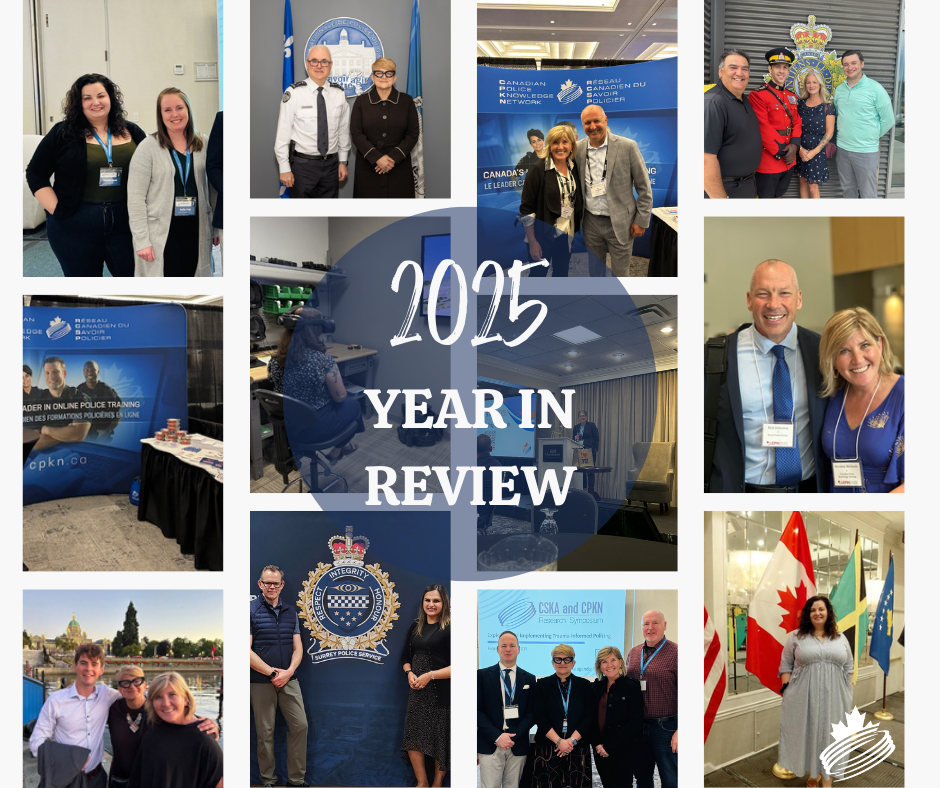

The last year has been an exciting time of change, growth, and renewed vision for CPKN.
By: Rachel Cutcliffe
The past year at the Canadian Police Knowledge Network (CPKN) has been marked by significant change, growth, and a renewed sense of purpose. The arrival of new President Sonia Poulin has brought a fresh perspective and innovative ideas. Her eagerness to connect and strengthen relationships has already created meaningful shifts that are making a big impact throughout the Network.
“The leadership transition at CPKN has been an important period of reflection and alignment, and has allowed us to build on our strengths,” said Krystine Richards, Vice President of Operations. “It’s helped us sharpen our focus, align our priorities, and has enhanced ways we support our Network.”
Strengthening Relationships and Building Partnerships
This shift in leadership was not only about aligning priorities, but also about how the organization listens, connects, and works together. A strong emphasis on relationship-building and understanding the lived realities of staff, partners, and members of the Network became central to the way CPKN approached its work.
“When I began at CPKN, connecting with staff individually was important to me. I wanted to understand their roles, their passions, and how each person fits into the organization,” said Poulin. “Meeting our Board of Directors (Board), National Advisory Committee (NAC), attending conferences, and meeting with as many police services and public safety organizations as possible was also vital. These visits allowed me to learn about the Network’s needs and start building and strengthening relationships.”
These efforts have made a real difference. Over the past year, CPKN has become a more connected and engaged Network, with members eager to collaborate and work together. This was especially clear during the development of CPKN’s new three-year strategic plan. Through a thorough and consultative process with the Board, NAC, staff, and members of the Network, a renewed mission and vision now guide the organization’s work to better serve policing and public safety.
“Our strategic plan inspires me. It truly reflects what I have heard across the country and the direction we want to move as an organization,” said Poulin. “At the end of the day, our goal is to serve as an extension of you, whether that is through knowledge, research, expertise, or all the above. We aim to be your trusted learning provider and a catalyst for transforming police and public safety, together.”
Turning Strategy into Action
This strategic approach has already led to important changes in how CPKN operates and delivers its work. An internal restructure has enabled CPKN to offer more courses as well as its primary communications in both official languages, English and French. There is also a greater focus on consistent and strategic communication, both internally and externally. The launch of a new website aims to boost engagement and fully showcase CPKN’s service offerings and how we can better support the growing Network.
The Department of Innovation has seen significant growth. The successful launch of its Research Arm and new national initiatives such as the Competency-Based Management Framework, the Extended Reality White Paper, and the Annual Literature Review have expanded its reach. Department staff have also positioned themselves as thought leaders in innovation and adult learning at several conferences, both nationally and internationally.
Enhancing User Experience
User experience has been a focal point for all Departments within CPKN. For example, all platforms have been enhanced with a focus on intuitive design, making it easier for learners to find information and complete tasks with confidence. Courses can now be built to be mobile-friendly, not just responsive. We have started working on enhancing our reporting system, which will be more user-friendly and better support training units and administrators
“Focusing on user experience is essential. A well-designed experience reduces friction, improves engagement, and lets learners focus on content, not navigation,” said Richards. “We see that good user experience leads to higher course completion rates and greater satisfaction, which ultimately, helps our Network.”
CPKN is also in the process of reviewing the French user experience and it has implemented processes to clearly identify when artificial intelligence is being used in courses, ensuring transparency and trust. Finally, work is underway to review the learning management system to ensure it remains the best option for the Network.
Strengthening the Network Together
There has also been stronger integration of the Professional Security Knowledge Network and eProctor Canada brands. These divisions support CPKN’s work by providing secure, real-time proctoring for exams as well as equipping security organizations with provincially licensed skills and knowledge. A key initiative for strengthening these brands involved conducting a comprehensive review of eProctor Canada’s user experience. This led to enhancements that are currently being implemented.
Finally, the Stanhope Conference, a long-time favourite within the Network, has been rebranded as the CPKN Conference. This event stands as CPKN’s marquee annual gathering, welcoming approximately 100 participants to Charlottetown each year. With clearer goals and a more defined target audience, the CPKN Conference offers a unique opportunity to witness the Network in action and fosters lasting connections.
“All of these efforts have created a better experience for our Network, and we’re just getting started,” said Poulin. “I’m encouraged by our progress and can see the positive impact for learners, training units, and leadership across Canada and beyond. I look forward to what 2026 will bring.”