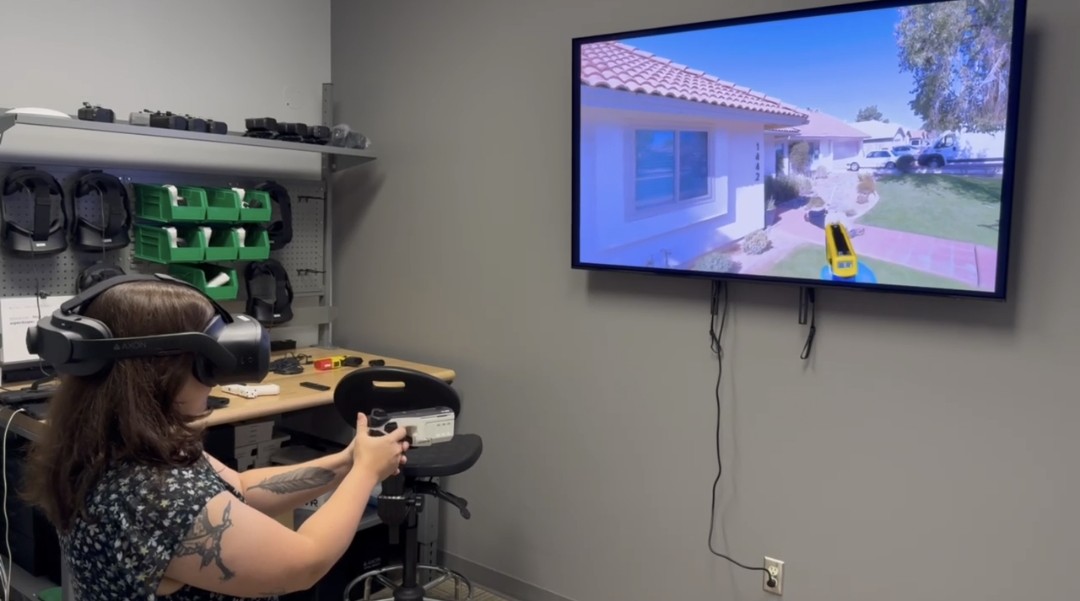

The white paper explores transformative potential of extended reality technologies in police and public safety training in Canada.
By Rachel Cutcliffe
The Canadian Police Knowledge Network (CPKN) has published a white paper examining the implementation of extended reality (XR) technologies in training for police and public safety agencies across Canada.
Over the last four months, Drew Pitchforth, Innovation Advisor, Department of Innovation, CPKN, led the study which engaged with 33 police services, training academies, academic institutions, correctional facilities, and public safety organizations to gather insights on their experiences with XR technology. This includes screen-based simulations, virtual reality (VR), augmented reality (AR), and mixed reality (MR).
“Throughout this project, we engaged in consultations, conducted focus groups, and collected written feedback from representatives across all provinces and various organizations of different sizes,” explained Chantelle Ivanski, Director of Innovation, CPKN. “This offered a comprehensive perspective on the use of XR technology throughout Canada and enabled us to identify key benefits as well as the challenges encountered during procurement, implementation, and training.”
The most common technology that was being explored or had already been implemented for training was VR. While some services and organizations had not begun considering XR technology at all. Of those who had implemented VR technology, a small number of services were also exploring AR and MR training.
Services and organizations that adopted VR training identified five key benefits they experienced in implementing the technology:
- Compatibility with current equipment that created easier integration.
- Cost savings from reduced personnel, supplies, and facility needs.
- Minimal space requirements and portability of the system.
- Subscription-based options for regular updates at no extra cost.
- Responsive vendors who enhanced the experience.
However, there are still several challenges according to study participants. Procurement and development barriers include high initial costs for purchasing from vendors, or, when developing a system independently, similar investments of time and financial resources.
Another challenge involves the intersection of provincially mandated training and technologically compatible curricula, which in some instances results in barriers or disconnects. Finally, technical issues persist for some participants, ranging from headset difficulties and connectivity concerns to calibration problems. While the involvement of tech-savvy instructors is helpful, and in some cases necessary, technology issues may still occur.
“Overall, we found that XR training technology is a great complement to live instruction but there are still barriers and challenges that exist for adoption for some services and organizations,” said Ivanski. “However, participants recognize that it is a valuable tool to augment existing programs and support live training, which remains necessary.”
To help support this work CPKN’s Department of Innovation, in conjunction with CPKN’s National Advisory Committee’s Innovation Subcommittee, has developed a VR Task Force which meets regularly and allows members to share experiences and learn from others. If you’d like to join, please reach out to communications@cpkn.ca.
To read the full XR Report, please click here: Extending Reality: XR Applications In Canadian Police And Public Safety Training.
Although the identities of study participants, service providers, and organizations are kept confidential, the Department of Innovation extends its sincere appreciation to all individuals and groups who contributed their insights and expertise.