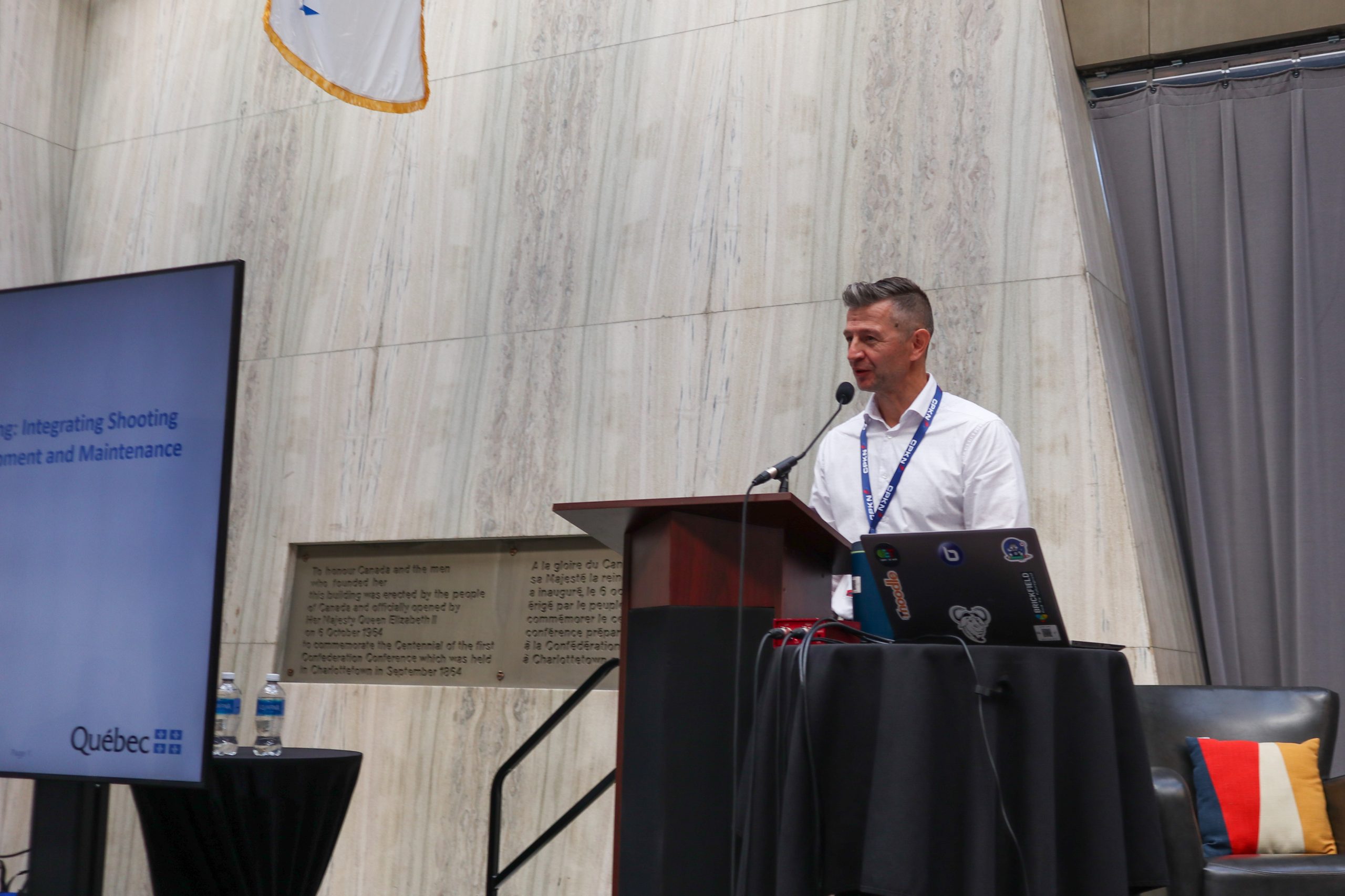

ENPQ’s simulation-enhanced training program aims to strengthen tactical judgment, situational awareness, and decision-making under pressure.
By Natalie Fournier
In 2023, Sergeant Maureen Breau of the Sûreté du Québec (SQ) died in the line of duty during a police intervention at a residence by the hands of a man with mental health issues and a lengthy criminal record. Following this tragic event, two investigative reports were conducted, recommending stronger firearms and critical thinking training.
The recommendations spanned to public safety stakeholders, including the École nationale de police du Québec (ENPQ). The academy, founded in 1968, started the work to implement the suggestions, which included redesigning firearms training programs to include virtual reality to teach safe decision-making skills and reflect real-life situations.
During the 2026 CPKN Conference, Roman Barba, Educational Technology Consultant at ENPQ delivered the presentation, From Technique to Decision-Making: Integrating Shooting Simulators to Improve the Development and Maintenance of Shooting Skills. Barba shared a new firearms training program that combines simulation technology, a dynamic pedagogical approach, and a research initiative to measure the impact of training on skill acquisition, retention, and transfer to actual policing situations.
Drawing on the research behind virtual simulation technologies, Barba highlighted how these tools can help officers develop and maintain critical situational awareness, tactical judgement, and performance under the high-pressure conditions they may encounter in the field.
“The goal is to determine not only whether virtual simulation technologies improve learning outcomes, but also whether they help bridge the gap between training and real-world application through more realistic scenario-based exercises,” says Barba.
ENPQ’s research project was broken up into four phases that explored defensive shooting skills in the current training program, introducing virtual reality to it, comparing the results, and the evaluation of skill retention months after a candidate is hired by police organizations.
The training platform included a range of decision-making scenarios delivered through three simulators: Aim Perfect, a live-ammunition shooting simulator with customizable rapid scenario creation capabilities; VirTra, an immersive virtual shooting simulator featuring a multi-screen environment; and VArmed, a virtual reality simulator that enables multi-user training and full-body tracking, replicating participants’ movements and gestures through lifelike avatars.
The research presented showed police candidates’ performance score and accuracy improve significantly during training, and those who are comfortable with weapons perform significantly better than those who are neither comfortable nor uncomfortable. Findings showed that a blended approach combining live and virtual learning settings is essential for police training objectives.
“As policing environments become increasingly complex, firearms training must evolve to reflect the realities officers face in the field,” says Barba. “While firearms-related incidents remain relatively rare, the consequences of these encounters can be significant.”
By incorporating blended learning approaches and simulation-based training, police organizations can better prepare officers for operational realities, ensuring they are equipped not only to meet qualification standards, but to make sound decisions in the critical moments that matter most.